






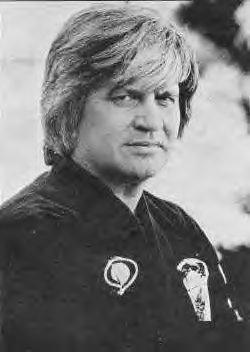
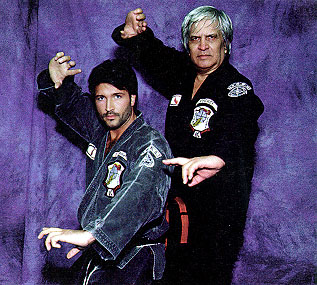
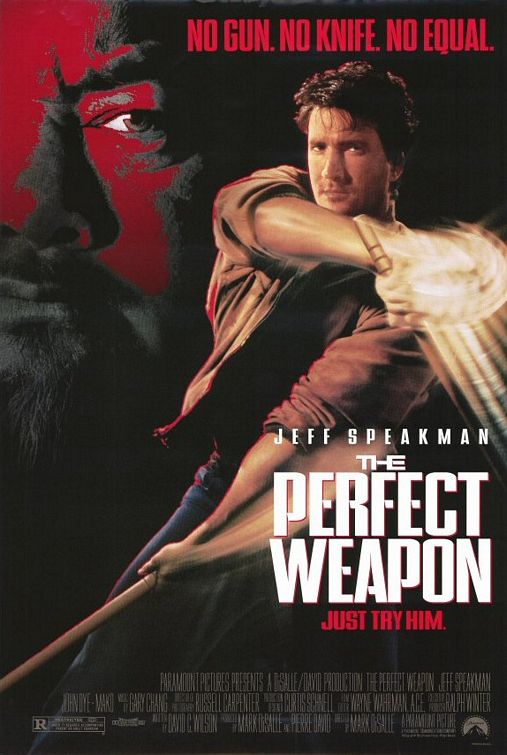
One the most well known Kenpo practitioners is film actor and 8th Degree Black Belt, Associate Professor Jeff Speakman. Mr Speakman has since gone on modify the Kenpo system which he calls Kenpo 5.0, it is the hybrid of the last generation version of American Kenpo taught directly from Senior Grand Master Ed Parker to Jeff Speakman and ground fighting brought into the equation by Mr. Speakman’s senior student Trever Sherman. Mr. Sherman has brought this type of combat back to Kenpo so he and Mr. Speakman could create Kenpo answers to defending against an opponent with these skills in the street.
He has modifyed the existing Kenpo system while remaining completely within the combat models and thinking of American Kenpo to address this increasing and prevalent void in the Kenpo world. By keeping within these models of Kenpo he has been able to develop a system combining the best of these two worlds to give our students the maximum ability to deal with the very real possibilities of becoming involved in these kinds of altercations.
Jeff Speakmans many accomplishments include the Black Belt Hall of Fame award for Instructor of the Year and his induction into the World Martial Arts Hall of Fame.
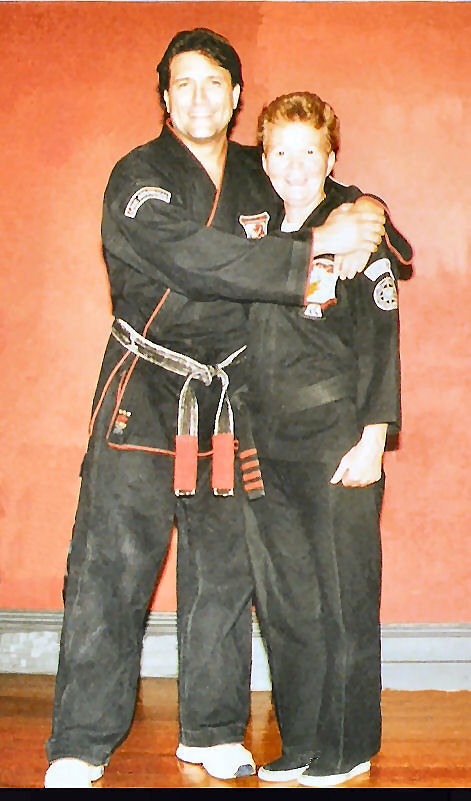
Associate Professor Jeff Speakman founded American Kenpo Karate Systems of which Associate Professor Jaki McVicar is the UK Director.
The Perfect Dummy!
Torquay Kenpo Karate Academy
Just some of the benefits our classes can offer?
- Truly effective self-defence technique development for juniors, women and men
- Development of power, stamina, cardio-vascular fitness, strength, flexibility, concentration, balance, body conditioning
- Fun, camaraderie, self-discipline, self-motivation, confidence, respect, coordination, self control
- An outlet for frustration and aggression in a controlled environment
- Regular belt testings that reward real attainment - not commercial prioritisation
- Opportunities to train at seminars in the UK, Europe, the USA and beyond with World renowned instructors
- No long term or 'rip-off' financial contracts - you can get more than you pay for through dedication and commitment!
How does the training attain these goals?
- Utilisation of positive reinforcement - particularly in respect of junior students - in a positive environment
- Pre-set self-defence techniques that teach motion and principles, allowing practitioners to develop spontaneous motion
- Use of impact pads for Kenpo Cardio and Kenpo Impact training
- Sparring to develop speed, awareness, hand-eye coordination, responsiveness, spontaneity, respect, control
- Encouragement of students to maximise their potential and maintain the class momentum

Kenpo Karate was developed by 10th Degree Black Belt, Senior Grand Master Edmund Parker 1931 - 1990.
When faced by a real attacker [s], it is crucial to dispense with him/them immediately. In order to achieve this you need a marital art that, not only, emphasizes speed and power, but teaches effective self defense techniques as well.
ENTER KENPO!
American Kenpo is one of the most comprehensive and contemporary systems taught today. Kenpo as a martial art dates back to ancient China, but Ed Parker, an experienced street fighter realised the need to update the oriental fighting arts for the modern environment. He literally disassembled, analyzed, and spent the rest of his life developing a fighting system that is practical, logical and realistic. It contains self defense techniques which are designed to demonstrate principles which can be used or adapted to work in self defence situations on the street. The techniques are fast and powerful, and are designed to overwhelm an attacker quickly and effectively. Practitioners are known for their incredible hand speed and explosive power.
Learning Kenpo is a study of motion and movement, Ed Parker’s Kenpo is scientifically structured into 4 areas of study: Basic Movements, Self-Defence Techniques, Sparring (competition and street) and Forms/Kata, and is thought of by many as the thinking mans fighting system due to its concepts, theories and principles of motion like physics, geometry and mathematics to assist with learning the system.
Kenpo is a self defence system first and foremost, primarily a striking art but with the addition of joint manipulation, throwing, strikedowns, footwork, and timing. Founded on logic, Kenpo students not only the "how's" of movements, but also the "whys" and "what fors".
The self defence techniques are at the core of the Kenpo curriculum, but as well as these we have many other aspects of training such as pad work, improvisation and weapons.
Kenpo techniques can sometimes become lengthy, and are considered by some as overkill; we consider Kenpo as merely being “over skilled”. Not every punch, kick, or strike is going to find its target or have the desired effect, so having a number of back up moves at your disposal is crucial.
The end result is a martial artist who is fast, powerful, and is actually capable of defending themselves, if the need were to arise. Kenpo Karate, simply stated, is designed to work.
Kenpo provides a strong integrated syllabus for adults and children. The depth of knowledge within the system means that the learning never stops for the student. We teach Kenpo to all ages and levels of physical ability. Kenpo’s emphasis on speed of action and accuracy over pure power, combined with it’s use of hard and soft movements make it easy to tailor to any man, woman, or child of all shapes, sizes, and ages.
The most important skill you will learn is how to avoid confrontations. However, should you ever have to protect yourself, we will make sure you are ready
People study Kenpo for many different reasons. Most for the practical self defense techniques to protect themselves and their loved ones, some like the sport aspect of training, while other may just want to improve their level of fitness. Whatever the reason, the benefits that Kenpo offers are always positive and many for mind, body, and spirit!
New members find that they warm to the style very quickly, and this is helped by a friendly and relaxed training atmosphere at the Academy. Don't worry if you have never tried Martial Arts before, there will be very capable instructors on hand to guide you through your first steps. Nobody is going to shout at you if you do something wrong!
We encourage an environment of mutual respect co-operation and discipline that helps build your confidence. Self esteem develops in students as they gain self confidence in their strengths and abilities. Team work and discipline are central to the 'Kenpo' family.
We welcome you to take a class yourself to see what this exciting practical martial art has to offer.
"Its not who's right, but who's left that counts."
Ed Parker